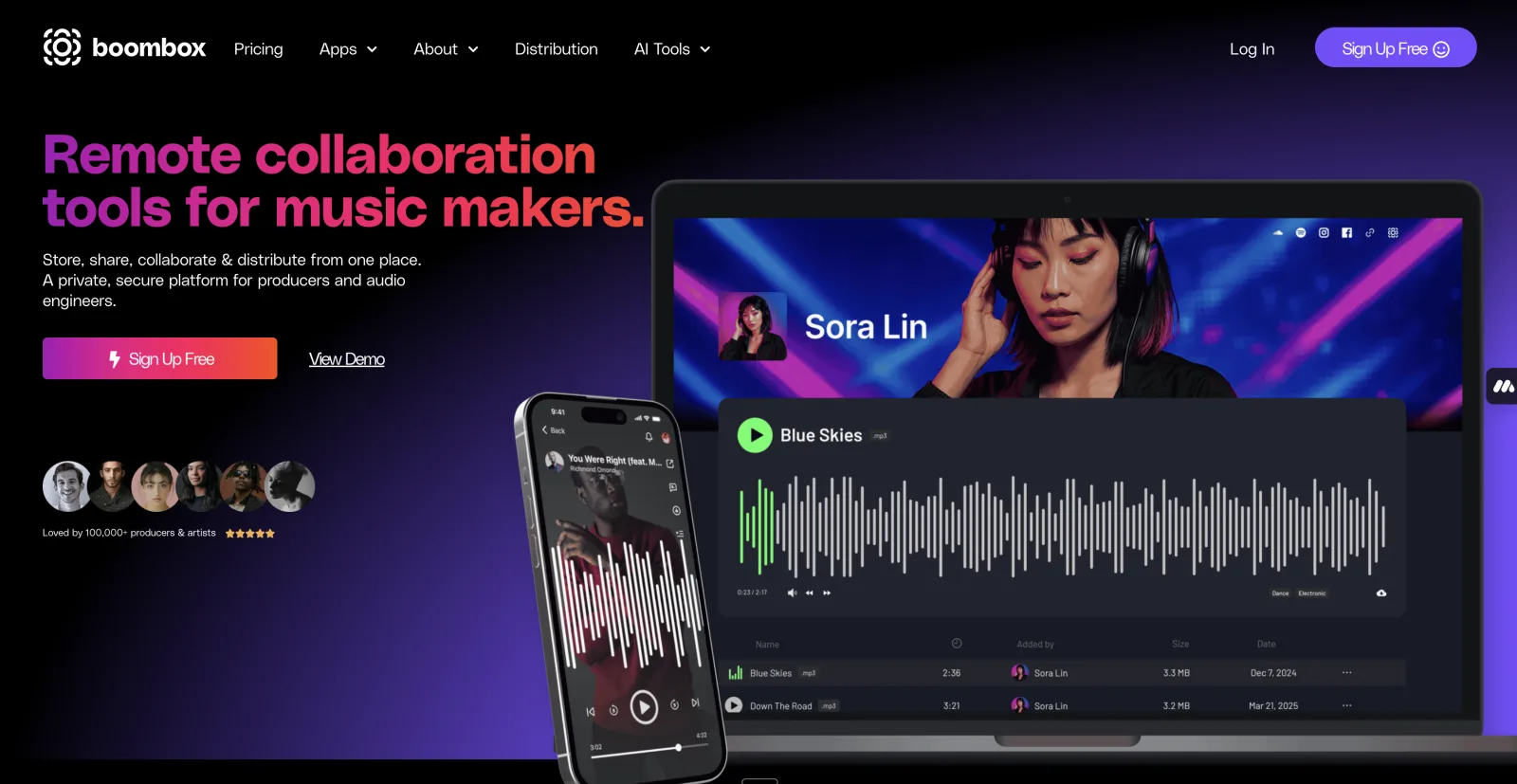
Boombox — Music Collaboration
Built the prototype that won seed funding, then took it to production serving 10,000+ musicians — audio/video recording, real-time chat, and music-asset sync across devices.
11.2020 — 12.2023Core developer — took the product from prototype to production.
React NativeWebRTCSocket.ioAWS S3
- Served 10,000+ users.
- Prototype secured seed funding for the company.
What I did
- Architected and implemented audio/video recording with real-time chat and music-asset synchronization.
- Built the initial prototype that carried the product through to its seed-funding round.
- Handled media storage and delivery on AWS S3 to keep recordings reliable at scale.
The problem
Boombox set out to let musicians collaborate remotely: record audio and video takes, layer them over each other's tracks, and talk in real time while doing it. When I joined there was an idea and a pitch deck; the company needed a working product — first to convince investors, then to serve real musicians.
My approach
I was a core developer from prototype through production over three years.
- The prototype — I built the initial iOS prototype that the founders took into their seed-funding round: recording, playback over a backing track, and enough of the collaboration loop to make the vision tangible.
- Real-time core — I architected the audio/video recording pipeline with react-native-webrtc, with Socket.io carrying both chat and WebRTC signaling over a single stateful connection.
- Media at scale — takes are large files recorded on mobile networks, so I built the storage layer on AWS S3 around resumable multipart uploads and a local-first sync queue — a recording is safe on the device the moment it stops.
- Stability work — I migrated the backend integration from GraphQL to REST without service interruption, and added unit, integration, and e2e test suites that sharply cut post-deploy bugs.
Challenges
- Musicians hear latency — layered recording is a synchronization problem; takes are timestamped against a shared session clock at capture and aligned at playback, with a manual nudge control as the escape hatch for Bluetooth output latency.
- The iOS audio session — recording while monitoring while playing a backing
track means competing
AVAudioSessionmodes; I centralized session state in one native-side manager and treated interruptions (calls, Siri) as first-class events.
Outcome
The prototype secured the company's seed funding, and the production app grew to serve 10,000+ users on the App Store and Google Play.